Skimlinks


Translate

Saturday, 19 November 2011

Wind and Solar Wind Hybrid System

Horizontal axis wind turbines (HAWT)

Horizontal axis wind turbines (HAWT)

Vertical axis wind turbines (VAWT)

Vertical axis wind turbines (VAWT)

maglev wind power generator

Maglev Wind Power Generator

solar wind hybrid map

Solar wind hybrid system

hybrid app-household

hybrid app-street light

Solar wind hybrid system

Solar systems

Solar On-grid system:
on-grid

on-grid

Solar Off-grid system:

off-grid

off-grid

Solar pump


There are two major types of solar pumps, DC (direct current) and AC (alternating current). 
DC solar pump: 
▪ power output up to 2kW
▪ suitable for small applications (garden fountain, landscaping)
▪ relatively low-priced (require slightly less solar panel)
▪ low compatibility (only selected controller work selected motor)

AC solar pump: 
A solar pumping inverter is needed in AC solar pump setup. The inverter converts DC generated from solar array to AC to drive the pumps in the mean time (as the controller) to control output and speed.
▪ power output range from 150W to 55kW
▪ suitable for all kinds of applications from landscaping to irrigation, especially large scale such as farmland irrigation, desert control, etc.
▪ high compatibility (inverter works with different kinds of AC motor and pump).

Energy Storage System


System consists of solar panels, battery and BMS (battery management system), converter, solar charger etc.
System Main Function
1. Electricity from PV panels powers the load and the surplus energy charges the batteries.  If the battery is fully charged, the energy will be back up to the grid.
2. When the electricity generated from PV is not enough, both PV and battery will power the load;
3. When there is no electricity from PV panels and no power in the batteries, electricity from grid will power the load.
4. When the electricity price is low at night, electricity from grid will charge the batteries.
Remarks: The system working mode can be changed and adjusted according to your requirements.

Wednesday, 16 November 2011

Solar-Powered Artwork Around the World


When Spanish researcher Nacho Zamora first stumbled upon an image of “Solarsail,” an energy-generating art installation in Switzerland, he knew he had found something different from the other public artworks he had been studying — and something important.
Since that discovery, Zamora has been carefully cataloging solar-powered artworks around the world and interviewing their creators for his Solar Artworks Project, an online compendium of public art that is aesthetically striking, environmentally sustainable, and raises awareness about crucial renewable technologies.
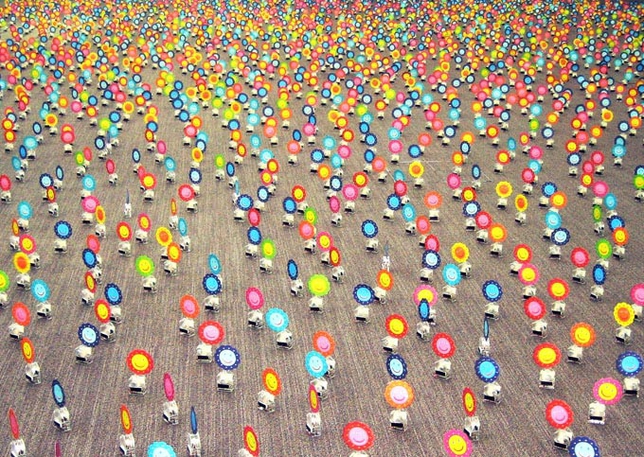
One example of such works is Belgium-based artist Alexandre Dang‘s “Dancing Solar Flowers.”
The flowers have brightened many of the halls of power in Europe, bringing color and playfulness to the European Parliament buildings in Brussels, Luxembourg, and Strasbourg, among numerous other exhibitions around the world.
Up to 10,000 multicolored “flowers” in each installation move when exposed to sunlight, creating a “dancing” effect. Though most shows to date have been temporary, the artist is currently preparing a permanent installation for a children’s hospital in Brussels.
“Solar artworks bring poetry to people and to mankind. They are also likely to raise awareness on the potential of solar energy,” says Dang, who also founded the organization Solar Solidarity International to help build renewable-energy facilities in places without access to conventional energy sources.

The World Is Locking Itself Into An Unsustainable Energy Future


The world is locking itself into an unsustainable energy future which would have far-reaching consequences, warns the International Energy Association (IEA) in its latest World Energy Outlook report released in London .
The International Energy Agency warned as it launched the 2011 edition of the World Energy Outlook (WEO) that without a bold change of policy direction, the world will lock itself into an insecure, inefficient and high-carbon energy system. The agency's flagship publication, released in London , said there is still time to act, but the window of opportunity is closing and rapidly. Delaying action is a false economy which the IEA baldly states that for every $1 of investment in cleaner technology that is avoided in the power sector before 2020, an additional $4.30 would need to be spent after 2020 to compensate for the increased emissions.

"Growth, prosperity and rising population will inevitably push up energy needs over the coming decades. But we cannot continue to rely on insecure and environmentally unsustainable uses of energy," said IEA Executive Director Maria van der Hoeven. "Governments need to introduce stronger measures to drive investment in efficient and low-carbon technologies. The Fukushima nuclear accident, the turmoil in parts of the Middle East and North Africa and a sharp rebound in energy demand in 2010 which pushed CO2 emissions to a record high, highlight the urgency and the scale of the challenge." 
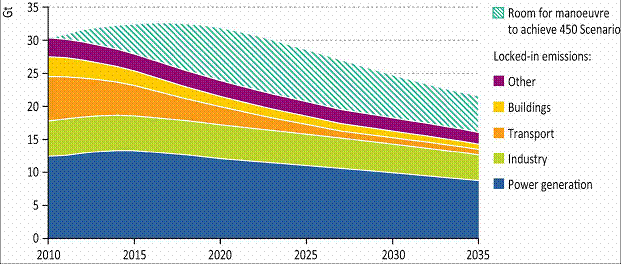
The door to 2°C is closing,but will we be “locked-in” asks the IEA?


World energy-related CO2emissions from locked-in infrastructure in 2010 and room for manoeuvre to achieve the 450 Scenario. Without further action, by 2017 all CO2 emissions permitted in the 450 Scenario will be “locked-in” by existing power plants, factories, buildings et al.

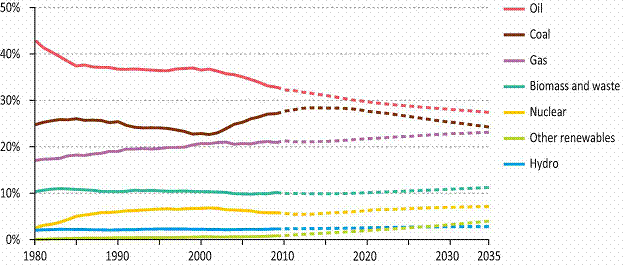
Shares of energy sources in world primary energy demand in the New Policies Scenario says natural gas and renewables become increasingly important
The global primary energy demand grows by 40% between 2009 & 2035,oil remains the leading fuel though natural gas demand rises the most in absolute terms

In the WEO's central New Policies Scenario, which assumes that recent government commitments are implemented in a cautious manner, primary energy demand increases by one-third between 2010 and 2035, with 90% of the growth in non-OECD economies. China consolidates its position as the world's largest energy consumer: it consumes nearly 70% more energy than the United States by 2035, even though, by then, per capita demand in China is still less than half the level in the United States. The share of fossil fuels in global primary energy consumption falls from around 81% today to 75% in 2035. Renewables increase from 13% of the mix today to 18% in 2035; the growth in renewables is underpinned by subsidies that rise from $64 billion in 2010 to $250 billion in 2035, support that in some cases cannot be taken for granted in this age of fiscal austerity. By contrast, subsidies for fossil fuels amounted to $409 billion in 2010.

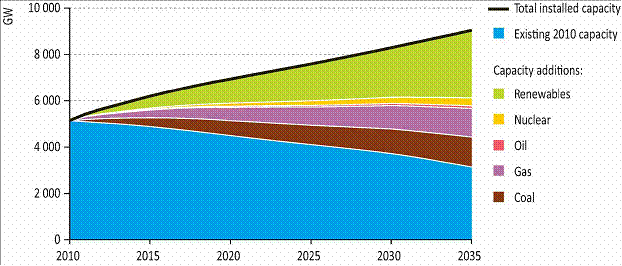
Global installed power generation capacity and additions by technology in the New Policies Scenario

Renewables and nuclear power account for more than half of all the new capacity added worldwide through to 2035

The IEA states that short-term pressures on oil markets are easing with the economic slowdown and the hope that Libya will recover to supply. But the average price of oil remains high, approaching $120/barrel (in year-2010 dollars) in 2035. As a consequence, reliance grows on a small number of producers mainly from the Middle East and North Africa (MENA) which is over 90% of the required growth in world oil output to 2035. If, between 2011 and 2015, investment in the MENA region runs one-third lower than the $100 billion per year required, consumers could face a near-term rise in the oil price to $150/barrel.

The forecast by IEA is that the oil demand rises from 87 million barrels per day (mb/d) in 2010 to 99 mb/d in 2035, with all the net growth coming from the transport sector in emerging economies. The passenger vehicle fleet doubles to almost 1.7 billion in 2035. Alternative technologies, such as hybrid and electric vehicles that use oil more efficiently or not at all, continue to advance but they take time to penetrate markets.
The use of coal, which met almost half of the increase in global energy demand over the last decade, rises 65% by 2035. Prospects for coal are especially sensitive to energy policies, notably in China , which today accounts for almost half of global demand. More efficient power plants and carbon capture and storage (CCS) technology could boost prospects for coal, but the latter still faces significant regulatory, policy and technical barriers that make its deployment uncertain.
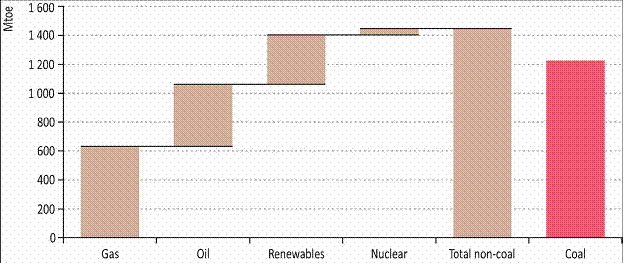
Incremental world primary energy demand by fuel, 2000-2010


Coal accounted for nearly half of the increase in global energy use over the past decade,with the bulk of the growth coming from the power sector in emerging economies

The catastrophe at Fukushima Daiichi according to the IEA has raised questions about the future role of nuclear power. In the New Policies Scenario, nuclear output rises by over 70% by 2035, only slightly less than projected last year, as most countries with nuclear programmes have reaffirmed their commitment to them. But given the increased uncertainty, that could change. A special Low Nuclear Case examines what would happen if the anticipated contribution of nuclear to future energy supply were to be halved. While providing a boost to renewables, such a slowdown would increase import bills, heighten energy security concerns and make it harder and more expensive to combat climate change.

The future for natural gas is more certain: its share in the energy mix rises and gas use almost catches up with coal consumption, underscoring key findings from a recent WEO Special Report which examined whether the world is entering a "Golden Age of Gas". One country set to benefit from increased demand for gas is Russia , which is the subject of a special in-depth study in WEO-2011. Key challenges for Russia are to finance a new generation of higher-cost oil and gas fields and to improve its energy efficiency. While Russia remains an important supplier to its traditional markets in Europe , a shift in its fossil fuel exports towards China and the Asia-Pacific gathers momentum. If Russia improved its energy efficiency to the levels of comparable OECD countries, it could reduce its primary energy use by almost one-third, an amount similar to the consumption of the United Kingdom . Potential savings of natural gas alone, at 180 bcm, are close to Russia 's net exports in 2010.
Russia remains a cornerstone of the global energy economy
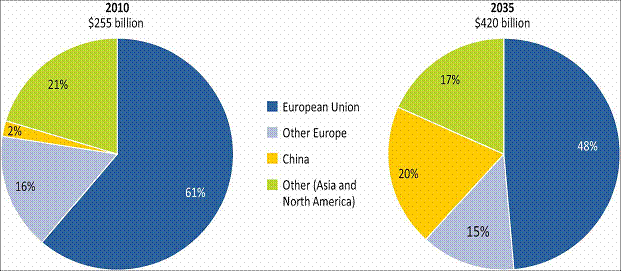
Sources of Russian revenue from fossil fuel export sales


An increasing share of Russian exports go eastwards to Asia ,providing Russia with diversity of markets and revenues

In the New Policies Scenario, cumulative CO2 emissions over the next 25 years amount to three-quarters of the total from the past 110 years, leading to a long-term average temperature rise of 3.5°C. China 's per-capita emissions match the OECD average in 2035. Were the new policies not implemented, we are on an even more dangerous track, to an increase of 6°C.

"As each year passes without clear signals to drive investment in clean energy, the "lock-in" of high-carbon infrastructure is making it harder and more expensive to meet our energy security and climate goals," said Fatih Birol, IEA Chief Economist. The WEO presents a 450 Scenario, which traces an energy path consistent with meeting the globally agreed goal of limiting the temperature rise to 2°C. Four-fifths of the total energy-related CO2 emissions permitted to 2035 in the 450 Scenario are already locked-in by existing capital stock, including power stations, buildings and factories. Without further action by 2017, the energy-related infrastructure then in place would generate all the CO2 emissions allowed in the 450 Scenario up to 2035.
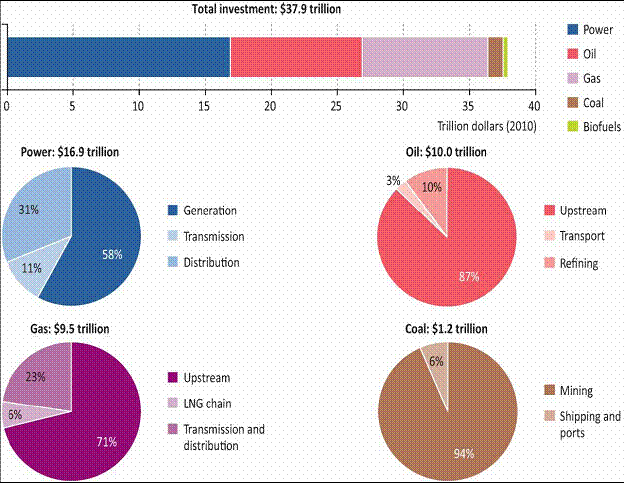
Investment is the essence of energy says the IEA. The graph shows the cumulative investment in energy-supply infrastructure by fuel in the New Policies Scenario, 2011-2035 (in year-2010 dollars)

A cumulative investment of $38trillion –almost $1.5 trillion per year –is required in energy-supply investment to 2035, with 45% in the power sector alonesays the IEA report.
Hopefully the leaders of the world's governments, who meet at Durban in December 2011 realise there is no time for pervication or procrstination but hard decisions need to be taken, as renewable energy is our only hope for a sustainable planet.


$1-Per-Watt Solar Modules Just Months Away

Historic $1-Per-Watt Solar Modules Just Months Away

The photovoltaic (PV) industry appears set to achieve a major milestone with
the selling prices of crystalline silicon (c-Si) modules projected to drop
to $1 per watt by the first quarter of 2012, a significant benchmark level
that could forestall a widely feared dip for solar installations next year
and stimulate demand instead, according to new IHS iSuppli research.

An assessment of this magnitude, bold in its purview and implications, comes
in the wake of an accelerated, rapid decline in pricing for deals following
the Intersolar Trade Fair, site of the world’s largest PV exhibition, held
last week in Munich, Germany. Going into Intersolar, spot prices from the
top Chinese brands, among the major players in the market, had been running
at $1.49 per watt for mainstream c-Si modules.


Sunday, 6 November 2011

Google-Funded Study Finds US Geothermal Power Capacity is Ten Times the Current Coal Power Supply

A new study shows that the United States has a geothermal power capacity that is ten times greater than the amount of energy produced by our current working coal-fired power plants. The study was funded by Google and conducted by Southern Methodist University’s Geothermal Laboratory where students and professors completed an in-depth map of the nation’s geothermal resources and found they aren’t just relegated to the areas in the west known for tectonic activity. The report revealed that even under the state of West Virginia, there is enough geothermal energy to immediately replace all of their coal-fired power plants.
The map above shows the findings of the study, with reds being the highest temperatures and greens the lowest. The researchers realized that though the east coast and central plains don’t have the high temperatures of the west, new technology can make it possible to use even the modest geothermal energy available to create electricity. A new technique called Low Temperature Hydrothermal, which uses naturally occurring subsurface fluids that exist at temperatures just below boiling to 300°F to create energy, is already being used in Alaska, Oregon, Idaho, and Utah and could be employed in many eastern states.

Saturday, 5 November 2011

10 Most innovative solar powered designs

Solar power is no longer just about slapping photovoltaic eyesores on existing rooftops to harness a bit of extra sun energy. Nowadays, people are finding unique ways to integrate solar energy into architectural, vehicular and even fashion designs from the beginning. Moreover, some innovators have even figured out ways to make structures entirely energy independent by combining various alternative energy sources. When solar was first introduced it was an auxiliary power source – now we have cars, boats, planes and even entire buildings that run on solar power. From the world’s first energy autonomous vehicle to solar balloons, arcs, lily pads and even bras here are some of the most clever contemporary solar designs.
The list of ten most innovative solar powered designs is as follows.
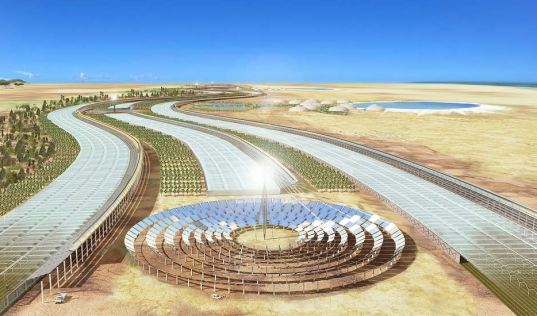
1. Power, water and food in the desert
This incredibly ambitious green design project aims to turn the Sahara Desert – one of the most notoriously inhospitable environments on Earth – into a lush green paradise. Concentrated solar power is used to generate energy for the complex and to evaporate seawater to use in greenhouses (as opposed to depleting freshwater sources). However, this is not a self-contained system – extra distilled freshwater and nutrients from the seawater as well as conditioned air will be released to create adjacent exterior micro climates more conducive to growing even in the outdoors, slowly changing the whole ecosystem back to something it hasn’t resembled for thousands of years and that can provide food, water and power in one of the most environmentally foreboding places on the planet.
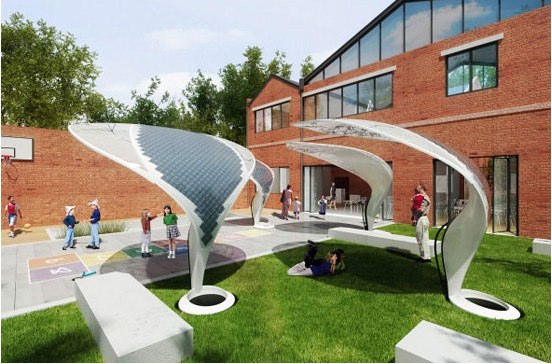
2. School powering solar shade system
While some solar innovations occur at grandiose scales, many smaller design steps can cumulatively make a gigantic impact as well. These clever solar shades serve multiple purposes at once by providing shade for students as well as power for their school. Moreover, they can be rotated manually throughout the day to provide maximum shade while simultaneously gathering the most energy – a win-win situation for students and administrators alike.
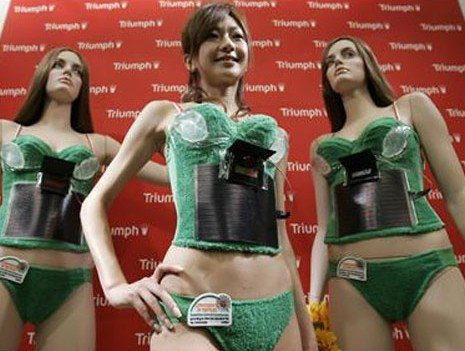
3. Sassy solar powered bra design
It is hard to say whether the solar bra concept is more geared toward a male or a female audience. The stomach solar panel is perhaps a little less sexy but supposedly generates enough energy to power a small mobile device such as an MP3 player or a cellular phone. The idea is interesting but the implementation is dubious.
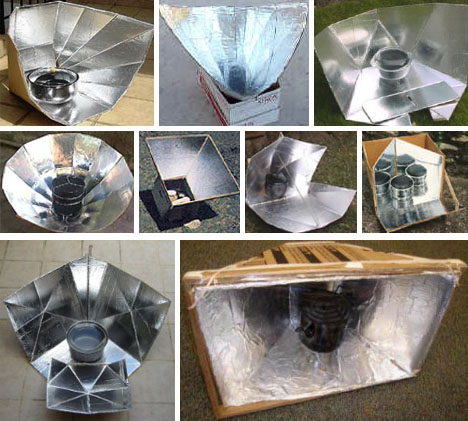
4. Creative DIY solar cooker designs
For solar do-it-yourself there is nothing quite like the classic solar cooker, applied in everything from emergency situations and developing nations to good old fashioned backyard barbeques. Best of all, some websites provide detailed user-submitted plans so you can choose one based on style, size and function and create it in the comfort of your own home.
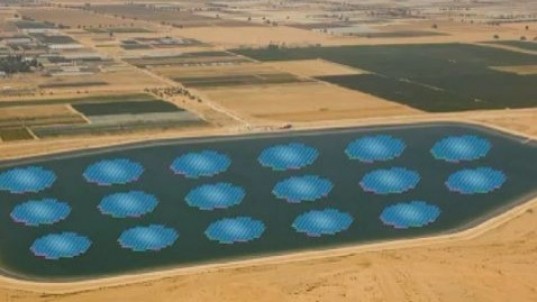
5. Floating solar collecting lily pads
Aesthetic integration is one of the core challenges of introducing alternative energy designs into an urban environment. How do you layer on solar panels, for example, without making them stand out as something foreign, additive and unattractive? One clever solution is the above solar energy ‘lily pads’ that truly keep the design element in mind – creating something visually engaging, a new layer on a lazy city river, while also generating a new source of alternative urban power.
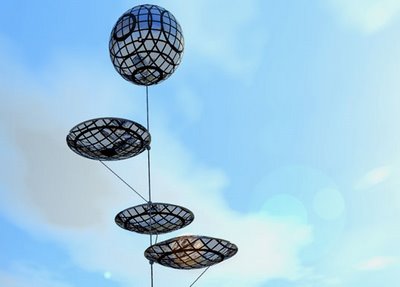
6. Floating energy collecting solar balloons
Sometimes one of the easiest solutions available is also the best. This incredibly simple design powerfully addresses classic problems of solar energy collection. It is very low impact, using minimum materials to harness the energy of the sun. It is spatially liberated, with floating elements that could essentially be added anywhere (urban or rural and in residential or emergency situations) without taking up any real estate or requiring excessive space or time to ship.
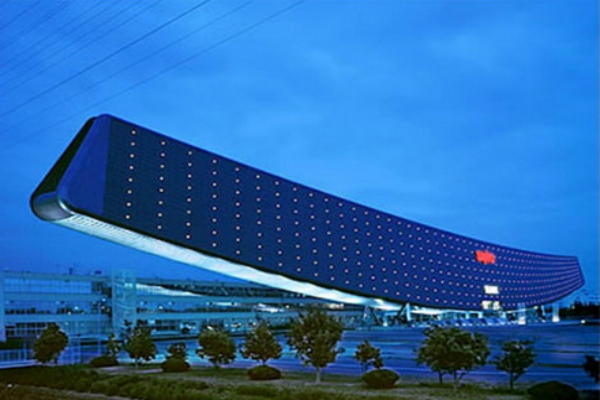
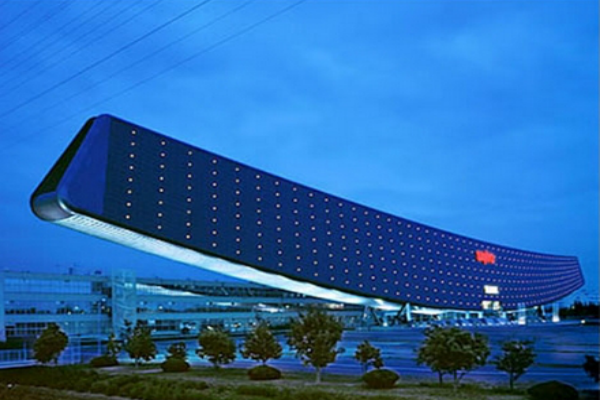
7. Canelievered solar power arc design
It has been called everything from Noah’s Eco-Arc to a giant stapler and many things in between. Born of a recall this structure was designed with reuse/recycling as well as alternative energy in mind. Following an unfortunate recall of a huge number of photovoltaic cells that simply could not be ethically resold Sanyo decided to use them themselves and create an amazing company structure at the same time.
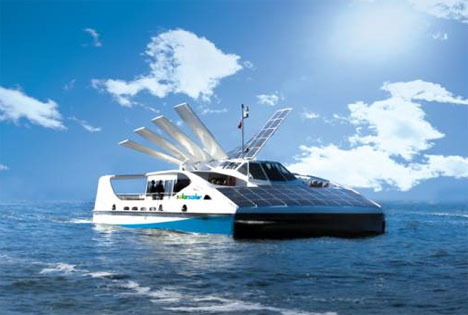
8. Creative solar powered ferry design
In a sleek, elegant and ingenious combination of solar and wind style and innovation this solar-powered ferry has fins that automatically adjust not only catch capture maximum rays from the sun but also to get the most out of available wind power possible – a great two-for-one public transit alternative energy solution.
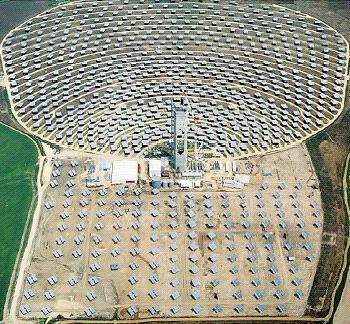
9. Solar energy concentrating power station
This first commercial solar power station in Europe is a sight to behold, appearing like an alien object standing out brightly against the flat surrounding landscape. An array of solar panels around the base are used to reflect the sun direct at the giant tower in the middle where, in turn, heat energy is used to raise the temperature of water piped through the structure. The panels are an awesome site to behold and rotate to track the sun throughout the year.
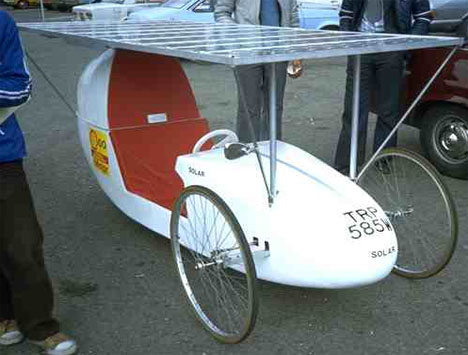
10. World’s first solar powered car design
There are plenty of snazzy super futuristic solar powered vehicles out there but where did the trend start? An Englishman in the late 1970s came up with this homely little hot-rod – supposedly the first truly solar powered vehicle and a DIY job at that – though concept models date back to GM in the 50s.