Skimlinks


Translate

Wednesday, 26 October 2011

Solar-powered rollerblading robot carries you to work on a chariot of humiliation

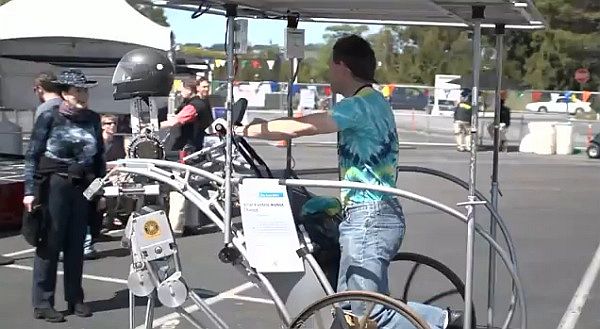
Bob Schneevis is at it again. The man who turned George W. Bush into a robotic Roman warrior has now developed something he calls the Solar Electric Robot Chariot. Showcased at this year’s Maker Faire Bay Area, Schneevis’ single-motor, bot-drawn carriage features a set of battery-juicing solar panelsand an array of cameras that control its chauffeur’s mechanized movements.


The bot, meanwhile, glides around on a pair of rollerblades and is designed to move its legs in the same way humans do — with the only difference being that humans don’t rollerblade anymore. Skate past the break to see the chariot coast around a parking lot with Mitchell Goosen-like grace.

Sunday, 23 October 2011

Apple Patents Next Generation Solar Technology

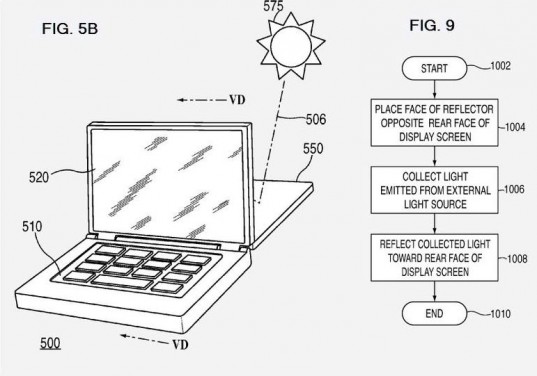
The US Patent and Trademark Office just revealed that Apple has been granted 20 new patents which focus on next generation solar technology. According to PatentlyApple, the patents not only cover solar technology being used to extend the battery lives of personal devices, but will also see the development of a cool new product – a specialized back panel reflector that uses sunlight to illuminate laptop screens.


According to design drawings from Apple, the back panel reflector uses a mirror pointed at the sun to direct solar rays towards a screen to supplement LED backlights with natural light. The patents also specify designs for future Macbooks topped with photovoltaic panels and plans for new solar cell assembly methods and apparatuses for assembling integrated circuit components to substrates.
These solar arrays can be used on small personal devices, enabling Apple devotees to use solar energy to recharge their future iPhones and iPads. Now, it is important to stress that these plans are still currently at the ‘patent stage’ – it will be years before we see this technology in our hands, but it’s good to know Apple is working on it. In an age when our personal devices are taking up a large chunk of our individual carbon footprints, it is reassuring to see technology companies looking at renewable and efficient ways to reduce them.

ASHRAE chapter is open at Our Hamdard University (HIIT)

ASHRAE is an international technical society that fulfills its mission of advancing heating, ventilation, air conditioning and refrigeration to promote a sustainable world through research, standards writing, publishing and continuing education.
ASHRAE

Engineering affects and enhances nearly every aspect of our lives, from the cars we drive to the clothes we wear. But perhaps nothing impacts our everyday life more than the safety and comfort buildings provide. The American Society of Heating, Refrigerating and Air-Conditioning Engineers (ASHRAE) truly engineers the world we live in.
As the world's foremost technical society in the fields of heating, ventilation, air-conditioning and refrigeration, ASHRAE is a society of more than 50,000 members across the world who share ideas, support research, and write the industry's standards related to energy efficiency, air quality and refrigeration. The result of these efforts is that the industry is better able to keep indoor environments safe and productive while protecting and preserving the outdoors for generations to come, ensuring a sustainable future.

ASHRAE fulfills its mission of advancing heating, ventilation, air conditioning and refrigeration to serve humanity and promote a sustainable world through research, standards writing, publishing and continuing education.

Address      1791 Tullie Circle NE, Atlanta, GA 30329
Website      http://www.ashrae.org
                                http://www.twitter.com/ashraenews


Saturday, 15 October 2011

The Solar Day 2011

1 – To create a national and international day of awareness and celebration of Solar Day, including:

A – The many benefits of solar energy and energy independence,

B – The creation of more sustainable lifestyles and businesses,

C – The adoption of green and clean-technology that does not adversely affect the planet and the atmosphere,

D – Through Solar Day activities in the U.S. and worldwide experienced by hundreds of millions of people and governments with the objectives of 40 nations participating by 2014.

E – Gain official recognition of Solar Day by the U.S. government as an annual day of recognition of solar energy and the goal of energy independence as a fundamental part of citizen and business sustainability objectives for the country.


Solar Day and Developing Countries
Through Solar Day’s Light the Night™ and Solar Villages™ programs, use low-cost solar as a tool for beneficial changes in the developing nations who need electricity for the most basic of functions:


1 – Provide electricity to pump clean water,


2 – Provide electricity to process crops, enable telephone and internet communication, enable solar-generated, battery-powered lighting for adults and children in villages all over the world – from India to Indonesia, Africa to South America – to learn at night, conduct commerce and improve their lives.


3 – Provide basic electricity and lighting to small villages currently without electricity and far from power lines for the most basic of needs which those of us in the developed countries take for granted.


4 – Work with solar manufacturers and the solar trade organizations in the developed countries in partnership with the United Nations, non-profit organizations and NGO’s to identify the areas of greatest need to implement these beneficial programs.

How to make an inexpensive solar powered charger


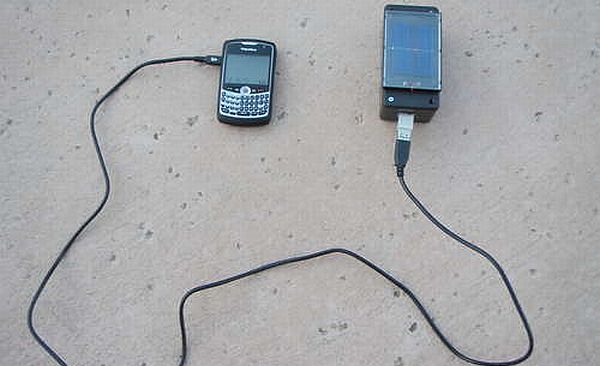
Building a solar powered charger to fuel small appliances can be structured by using some basic equipments. Increased use of solar panels has made its availability easier. Solar panels are available in all possible sizes from bigger to a smaller one and that too at affordable prices.
It is not a very complicated procedure to structure a solar powered charger.
Here are the steps to make a solar powered charger:
1. Collection of the required toolsThere are certain specific tools which are required for making a solar powered charger. So the first step is collection of the required tools. The required tools include AA batteries, Battery holders, a USB extension a/a cable, electrical tape, glue gun or tape to hold the pieces in place,terminal strip or soldering iron, blocking diode, a drill, a 6 volt solar panel.
2. Selection of the diodeStandard diodes drop the voltage by 0.6 V, while the Schottky diode drops it by 0.2 V which can be a deciding factor in whether the charger works or not. So it’s better to choose a standard diode which will ensure quality of the functioning of the charger.
3. Cutting the USB cableTo build the kit, cut the USB cable at the end which has the jack and remove everything except the red and black wire. This cable will be used in constructing the circuit.
4. Testing the solar collectorsCheck the solar collectors before connecting it to the circuit to be sure that it is working. It should yield the output of 2 volt inside the room and 2.5 volt in bright sunlight.
5. SolderingThe next step is soldering to make a circuit. Solder the red wire of the cable to the diode and then the diode to the red wire from the solar panel. In the next step solder the black wire from the solar panel to the cable. This completes the step of soldering. Soldering creates a serial connection which adds the voltages together, giving an output between 4 and 5 V, which is the required voltage for operation of a standard charger.

6. DrillingThe next step is drilling. Drill a hole for the cables, to make it pass through the solar panel. This completes the step of drilling.
7. Finalizing the setupThe next step involves the fitting of the components of the solar charger into the project box. It should be done with caution as recklessness in final step could disturb the whole model.
8. Testing the finalized solar chargerConnect any one of the gadgets with minimal power requirement to the finalized solar charger to test it out. Ensure that solar panels are exposed to bright light and allow the charger to charge the gadget. It’s better to turn off the gadget while charging.

Caution while using solar charger

1. Place the charger in an open area where the solar panel gets enough light to convert it intoelectrical energy. If the solar panel does not gets ample light, it will not function appropriately.
2. Don’t connect the charger to a gadget with higher energy demands as solar charger has its own limit as it should be used in accordance with the outermost capacity.
3. Don’t cross connect the charger to any other source of electric charge as it may damage the charger. It should be ensured that the charger is properly connected to the gadget .
4. Use the charger to charge the gadgets in switched off condition. It will increase the life of the solar panel.
5. Give appropriate time to the solar charger to charge the connected gadget as it depends on the intesity of light hitting the solar panel.

Turning Seaweed into the Fuel of the Future


Seaweed holds promise as more than an ingredient in a purifying face mask or a maki roll.
So say researchers at E.I. du Pont de Nemours & Co., which alongside Seattle-based Bio Architecture Lab (BAL) has secured $9 million from the Department of Energy to explore seaweed’s potential as a feedstock for biobutanol, an advanced bio-fuel.
Their venture appears to have largely cornered the current market. Though more than 200 companies have looked into algae-based bio-fuels, DuPont and BAL say most others have shied away from using macroalgae, like kelp.
“We’re in the vanguard here on this technology. There are other people who have talked about changing microalgae — green algae that floats in the water — into advanced biofuel, but [using] seaweed is unique,” said DuPont’s Nathan Danielson, a program manager who oversaw the companies’ DOE grant application.
That’s why the companies were able to win one of DOE’s Advanced Research Projects Agency-Energy (ARPA-E) awards, announced late last month, which are designed specifically for ambitious “high-risk, high-payoff” energy research projects.
Part of the reason seaweed hasn’t taken off as a biofuel source is that it’s not part of American culture, said Nikesh Parekh, CEO of Bio Architecture Lab. “Our founders are from Japan, and they are much more familiar with seaweed farming and seaweed as a culture crop.”
Planting a large-scale seaweed farm would likely come up against stiff opposition from those who are not used to seaweed farms in their backyards, agreed Mike Graham, an ecologist specializing in seaweed at the California State University-associated Moss Landing Marine Laboratories.

Pakistan Regulator Seeks Approval of Feed-in Tariffs for Wind


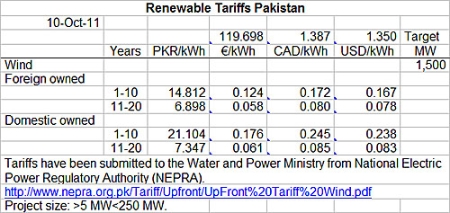
Feed-in tariffs for wind energy have been submitted to the Water and Power Ministry from Pakistan’s National Electric Power Regulatory Authority (NEPRA).
NEPRA has proposed a novel two-tier system of tariffs depending upon ownership. Pakistan will pay foreign wind developers less than domestically-owned companies.
If the proposed tariffs are approved by the Ministry, Pakistan would leap ahead of any feed-in tariff proposal for wind energy in North America. The targeted wind capacity of 1,500 MW is alone significant. Possibly more significant, however, the proposed tariffs are not simply fixed at one single price for 20 years. Instead the Pakistani tariffs are differentiated by decade. For example, the tariffs during years eleven through twenty are half those during the first ten years of the contract. Payment in this manner approximates repayment of debt and equity during the first decade. After debt retirement, the tariff can be substantially reduced while still maintaining the desired return on equity sufficient to attract investment.
Project size: >5 MW<250 MW.
Program is open only to the end of 2012 and limited to a total of 1,500 MW.
Financing must be closed 12 months after contract is awarded and projects must also be completed within 18 months.

Sunday, 9 October 2011

Heating Oil Futures (HO) to be Discontinued April 2013

Due to regulatory change to lower sulfur heating oil specifications in New York State, the Exchange will only list three (3) additional months through April 2013 in the New York Harbor Heating Oil futures (HO) contract.  There will be no additional months listed in the HO contract beyond the April 2013 contract month.  The New York Harbor ULSD futures contract (LH ) is listed concurrently with the HO contract, and will replace the HO contract after it is discontinued in April 2013.

Saturday, 8 October 2011

Converting Municipal Waste to Renewable Energy Source

Municipal waste to energy is a fantastic way to turn the garbage we discard into a renewable energy source that can help heat and power our homes. Municipal solid waste, also called MSW, can be a big renewable energy source that has other environmental benefits as well. When our garbage is turned into municipal waste energy, the benefits are numerous. There is less garbage to clutter and fill our landfills, so that fewer landfills are needed and less trash is thrown out.Municipal waste to energy programs also lessen the demand for oil and other fossil fuels, because the energy converted from the MSW is used instead of oil or other fossil fuels. There are already many municipal waste to energy facilities located in the United States, and the state of Kentucky generates enough energy from waste to energy facilities to power hundreds of thousands of homes each year.


Municipal waste to energy facilities operate in one of two ways. These facilities can burn the MSW and use the energy released to create heat and steam, which can be converted to electricity. The second way to convert waste to energy is by collecting the methane gas that is released when MSW decomposes. For every ton of municipal waste that is converted into energy, there is one barrel less of oil or about a quarter of a ton of coal that is not needed. Even with the waste to energy facilities that are already in operation, almost three hundred million tons of municipal waste is sent to the landfills every year. This means that there is an enormous potential to increase the municipal waste energy substantially. If all municipal solid waste was converted into energy instead of simply discarded, we could end up reducing our dependence on oil and coal by at least three or four percent, which translates into hundreds of thousands of barrels of oil and thousands of tons of coal.


Municipal waste is a renewable energy source that shows great promise, and all waste to energy facilities follow almost the same procedures when the waste is first received. The waste is sorted, with recyclable materials being set aside. Even tires and many plastics can be turned into energy, but metal cans and other items that can be reused are removed and set aside. At this point, a waste to energy facility that burns the waste will put the materials into the incinerator to burn, so the released energy can be captured in the form of steam. This steam is then used to create electricity.
Municipal Solid Waste

The most efficient and effective way to convert municipal waste to energy is to use landfills created for this purpose. These landfills are designed to maximize the production and recovery of the methane gas that is created by decomposing waste in the landfill. Methane gas can be dangerous when it builds up, and some landfills will simply burn off the gas safely, to remove it and keep it from building to dangerous levels. In a waste to energy landfill however, this gas is collected, purified, and then either used or sold to utilities and other businesses. These landfills are designed to make it easier to recover the gas, and encourages the municipal waste to decompose more quickly, producing more methane gas as a result.

Municipal waste is an alternative energy source that is renewable, sustainable, and eco-friendly, and this renewable energy source may be the answer to an energy crisis. Your garbage leaves your home as rash and comes back in the form of electricity, while protecting the environment and eliminating the need for oil and other fossil fuels. Metals are removed before municipal waste is converted to energy, and this means mining for metals will be reduced because of recycling and lower demand.

Waste to Energy Technology Solutions


Green Energy is the way to go..


Help Protect Our Earth!


Some important things to consider in our daily routine in order to conserve energy....


MAKE A DIFFERENCE EVERYDAY
  • Turn off lights, TV and other home appliances when you are done with them.
  • Use Products with the Energy Star label.
  • Don’t leave water running while brushing your teeth or shaving.
  • Use both sides of a piece of paper before throwing it away.
  • Don’t leave doors to the outside open for longer than necessary.
  • Talk to your friends and family about Saving Energy.
  • Choose Your Colors Wisely The colors in your House can Reduce Your Energy Bill

Thursday, 6 October 2011

Why Solar Energy is not getting popular in Pakistan?

Solar energy getting popular across the world is also the best viable solution to energy shortages in Pakistan provided that the government invests or at least makes investor-friendly policies and implements them, too, said entrepreneurs and energy experts in interviews regarding the current market status for solar energy commodities and its future prospects.

Right now, they said, country’s progress in exploring solar potential for electricity generation was depressingly slow despite having perfect conditions for the same. Pakistan should learn from countries such as Bangladesh, which witnessed the fastest expansion of solar use in the world that, according to a World Bank report, changed the face of its remote, rural areas, the experts added.
They were of the opinion that the government should legislate to make compulsory the use of solar energy for electricity generation in development projects and specific residential use to meet energy shortages. It should also stop further extension in the transmission lines and put the entire funds meant for village electrification to solar use.
“If the government does so, I can bring a solar energy revolution in Pakistan,” said Dr Nasim A. Khan, the vice chancellor our Hamdard University, a PhD in solar energy and author of last year’s book on ‘Energy sources and their utilisation in Pakistan’.
“The government has to make an initial investment in order to create a market. Once a market is in place, the rest of the job would be taken over by the private sector as it happened in case of Bangladesh where the private sector is now actively engaged in the solar market and 10,000 solar systems are being installed every month in a village,” he said.
Dr Khan, who served the army for over 30 years, was awarded a PhD scholarship on ‘Solar energy guide and data book’ that he wrote in 1986. At the Colorado State University where he went for his doctorate, Dr Khan designed the world’s cheapest solar cell with the help of cadmium telluride. In Pakistan, he worked extensively on solar installations that included 3,000 homes in the interior of Sindh and over 3,000 army posts for lightening purposes.
“The system is still working at places where people have maintained batteries. We had also established an experimental research solar lab at over 18,000 feet above the sea level, near the K-2 base camp, in the late 1990s,” he said.
Dr Khan designed a number of renewable energy products largely from indigenous material that included cookers, water heating and lightening systems, desalination plant, water pump, all running on solar energy, solar/thermal steam turbine and processes for extracting bio-diesel from Jatropha (a plant that can grow in marginal lands) and castor oil. All products are on display at the Hamdard University where he introduced energy engineering and management programmes a few years ago.
He was of the opinion that Pakistan’s energy crisis would deepen. He said: “We have limited gas reserves while oil is getting costlier day by day. No big project in hydro or coal power can complete in less than 10 years. Hence, we are left with only two options: wind and solar energy,” he said, adding that the quantum of solar energy reaching Pakistan had 33,000 million times more potential than its hydropower potential.
Asked if he had ever tried to convince the government on solar use, Dr Khan said his meetings with top officials and industrialists had so far remained futile.
“The problem lies with our defeated mentality that is unable to grasp the idea that we, too, can create. I can make a solar water heater for Rs200 for villagers. It might not be that reliable as we have in the urban areas, but surely it would suit the needs of rural life. But, first, the government needs to make a commitment and deliver,” he said.
Market situation
Right now, there are very few outlets in Karachi selling solar systems and gadgets. Products on the sale include solar-powered fans (at an approximate cost of Rs8,000), mobile charger (Rs1,000), geysers (between Rs20,000 and Rs75,000), laptop charger (between Rs6,000 and Rs16,000), uninterrupted power supply system (minimum price Rs95,000), generator running on both diesel and solar energy (minimum price Rs350,000 per KV with battery), different types of lights (Rs600 to Rs10,000) and solar systems for residential use (cost depends upon the capacity for electricity generation and requirement).
All products are imported from China.
The entrepreneurs, seemed disappointed by poor public response and lack of government support.
“Troubled by electricity crisis, a number of people turn up daily. But, few actually return to buy anything,” said Afsar Ali, running a shop exclusively for alternative energy systems in Saddar.
The actual buyers, he said, came from the interior areas of Sindh and Balochistan either facing severe electricity shortages or not linked to the national grid. “We design solar system packages according to their requirement and affordability. However,
people in the urban areas usually find the initial investment for solar use higher and lose interest,” he said, adding that little realisation existed about the fact that pay-back time for the solar cost was only three years.
Regarding the impact of significant global reduction in the prices of solar panels, Khursheed Iqbal, Mr Ali’s brother who has been in the solar business for over 10 years, said that it was insignificant because of the continued devaluation of rupee.
He was of the opinion that 200 megawatts could be saved in Karachi only if the government converted streetlights onto solar energy.
Counting the benefits of solar energy use, Jamil A. Malik, running his business in renewable energy sources on Khalid Bin Waleed Road, said that it was pollution free and required little or no maintenance. With no operational cost, solar energy was
very economical for remote areas, he added.
“Village life comes to a standstill in the evening. Solar energy use will help improve the quality of life, reduce deforestation, alleviate poverty and prevent mass migration to urban areas,” he said.
He said the present situation was grim and the government was yet to make any progress on the decision it had made a few years back that 10 per cent of the country’s energy needs would be met through the use of solar energy.
Citing international studies, Naseer Ahmed, heading the Renewable and Alternative Energy Association of Pakistan (Reap), said that solar energy would be the cheapest form of energy by 2030.
“We believe that solar use is bound to spread in a natural way even if the government doesn’t support because other sources of energy are getting costlier and unavailable. Having said that, government support is crucial so that all energy needs are
timely met and all sections of society benefit,” he said while highlighting the need for a market to start solar cells
manufacturing in the country.
Youngest Nuclear Scientist

RENO: American Taylor Wilson has become the world's youngest nuclear scientist at the age of 17. Taylor spends his time advising the US Department of Energy on nuclear fusion research.

Taylor's name has been included in the Guinness Book of World Records. At age 7, he had memorised every rocket made by the US and Soviet governments from the 1930s onwards. At age 11, Taylor was mining for uranium with his dad in the New Mexico desert and at age 14 he become the youngest person in the world to build a nuclear fusion reactor.